
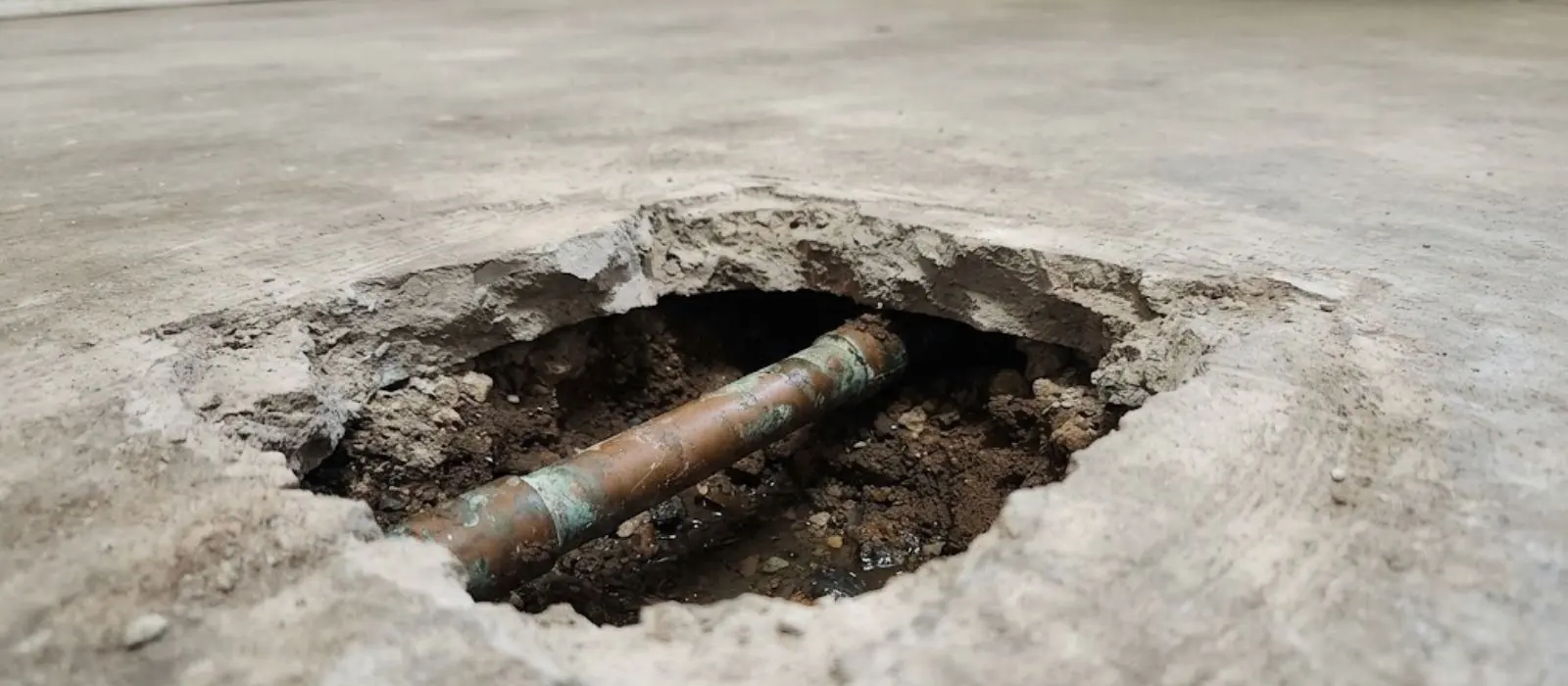
Supply lines versus drain lines
| Line | What goes wrong | Sign. |
|---|---|---|
| Supply (pressurized) | Pinholes, joint failure, rubbing on gravel | Meter moves, hot spot, running sound. |
| Drain (gravity) | Cracks, offsets, roots, bellies | Backups, gurgling, wet slab edge, odor. |
A drain leak does not push water the way a supply leak does. It seeps during use and may show as a smell, damp spot or settling floor.
How a drain under the slab is checked
A camera goes in through a cleanout and travels the line. The plumber sees cracks, offsets and root entry, and can measure the distance to each one. Sometimes a locator on the surface pinpoints the camera head.
That lets the plumber cut a small opening above the problem. Read more on sewer inspection.
Repair paths for slab drains
- Breaking a trench in the slab and replacing a section.
- Lining a cracked run from the inside.
- Rerouting the drain outside the slab.
- Replacing the full drain run when pipe is failing.
Lining works when the pipe is round and continuous. A collapsed run needs digging. The camera report decides, and your plumber should show you the footage.
Repair paths for slab supply lines
Supply lines can be repaired at the leak, rerouted through walls or replaced as part of a repipe. Our slab leak repair page walks through the choices, and the burst pipe repair page covers emergency steps if water is on the floor.
If you hear running water or find a hot spot, shut off the main and call.
Slab homes in the valley
Slab construction is common in Valencia County. The soil in the Rio Grande valley varies from sandy to clay, and moisture changes can move a slab slightly over time. That movement is enough to stress a rigid drain joint.
In Bosque Farms, trees near the house add root pressure to drains under and beside the slab. In Belen, older slabs may have cast iron or clay drains that fail at joints.
Restoring the floor
After the repair, the opening is filled with concrete. Flooring on top may need to be matched. Ask your plumber who handles the finish, because many plumbers stop at concrete and do not tile or lay wood.
If you have tile you want to keep, ask the plumber to cut along grout lines. It makes the patch easier to hide.
Insurance notes
Policies differ on slab work. Some cover water damage but not the repair of the pipe under the slab. Ask your agent before you decide. Photograph the camera footage and the damage for your file.
We do not state what your policy covers because it varies.
Signs that point to a drain under the slab
- Sewer smell inside the house with no clear source.
- A damp or stained spot on the slab near a wall.
- Floor tiles that crack or lift in a line.
- Backups that return after cabling.
- Water pooling at the foundation edge after you run water inside.
Any of these can have other causes. A camera and a locator separate drain trouble from supply trouble.
Why root intrusion under slabs is common
Roots grow toward moisture and warm, nutrient-rich water. A cracked drain under a slab is an ideal target. Roots may enter through a tiny gap and thicken inside the pipe, blocking flow and widening the crack.
Cutting the roots clears the blockage for a time. Repairing the pipe stops the cycle. Ask your plumber for footage of the break so you can see what you are paying to fix.
Choosing a contractor for slab work
- Ask whether they use a camera and a locator before cutting.
- Ask how they protect your flooring and belongings.
- Ask who handles the concrete patch and the finish.
- Ask for a written scope and the permit plan.
- Verify the contractor’s license on the state lookup.
Slab work is physically demanding and noisy. A contractor who explains the process and the schedule up front is likely to run a cleaner job.
What to expect during the work
Expect noise, dust and a few days of disruption. Breaking concrete is loud, and the crew uses vacuum equipment to control dust. They protect floors with plywood and set up a work zone with plastic sheeting.
The water or sewer may be unavailable for part of the day. Plan for toilets and showers. After the pipe work, the crew pours or patches the slab and waits for it to cure.
Ask when you can walk on the patch and when flooring can go back. Setting tile too early can crack the patch.
Drains under the slab and the cleanout
Every drain line under a slab should have a cleanout, a capped access pipe where a camera or cable can enter. If your house has none, the plumber may add one during the repair. It makes future work faster and cheaper.
Locate your cleanout and keep it clear of mulch and landscaping. Write its location on your home records so the next plumber can find it quickly.
Preventing slab plumbing trouble
Keep roots away from drain lines, avoid pouring grease, and use a hair catcher. Watch your water meter now and then. Keep landscaping from piling soil against the slab edge, because it traps moisture.
If you have a slab, learn where the main shutoff is and where the cleanout sits. In a slab emergency, those two locations save time.
Common slab plumbing mistakes
The most common mistakes are cutting without a locate, skipping the pressure test, patching with the wrong concrete and not documenting the repair. Each one can lead to a repeat problem.
Ask the plumber to walk through these steps before they begin.
Slab drains and the code
Drain lines under a slab follow the Uniform Plumbing Code (UPC) for slope, joints and cleanouts. Ask for a pressure or water test on any section that is replaced.
Slab plumbing questions
Often yes. Camera and locator work can limit the opening, and lining avoids digging in some cases.
A moving meter with everything off points to supply. Backups and odor point to drain.
Ask the plumber. Some do concrete only.
If water is on the floor, yes. Shut off the main and call.
Yes. See Rio Communities.