
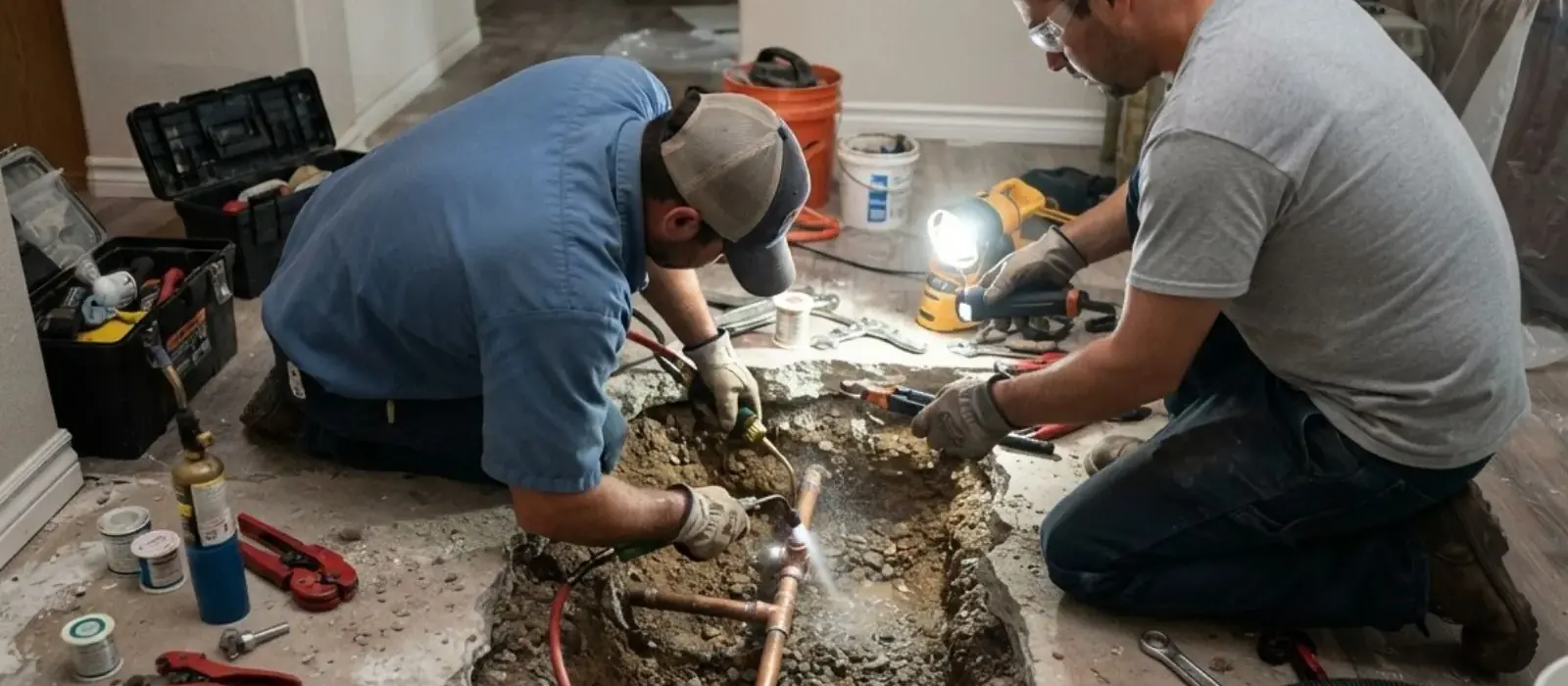
Signs of a slab leak
- A warm or hot spot on the floor that you can feel with bare feet.
- A water meter that keeps moving when every fixture is off.
- The sound of running water when nothing is on.
- Damp carpet, curling flooring or a musty smell.
- A sudden jump in the water bill.
A single sign can have other causes. Two or more together make a slab leak likely, and the next step is a test.
How a slab leak is located
The plumber isolates the water line and checks if pressure holds. Listening gear picks up the sound of the leak through the concrete. Thermal imaging can show a hot line. Tracer gas works when sound is weak.
Locating first matters because it limits cutting to the smallest area. See leak detection for more on each tool.
| Option | How it works | Best fit. |
|---|---|---|
| Spot repair through the slab | Cut a small opening, repair the pipe, patch the concrete | One leak on a pipe in decent shape. |
| Reroute through walls or attic | Abandon the buried line, run new pipe overhead | Several leaks or hard-to-reach pipe. |
| Repipe the house | Replace the supply system | Old pipe failing in many places. |
| Pipe lining | Coat the inside of the pipe | Sometimes used for certain pipe conditions. |
Which option fits
A single leak in otherwise sound copper is often a spot repair. A house with several leaks in a few years is a different case, because a repair fixes one point and the next weak point fails soon after.
If that sounds like your house, read about repiping before choosing. Rerouting is often a middle path.
Slab homes in Los Lunas, Belen and Bosque Farms
Many homes built on slabs in the valley run supply lines in or below the concrete. Soil moves with moisture and seasons, and pipes can rub on rock or gravel. Hard groundwater can also wear on metal pipe over time.
The Village of Los Lunas draws water from the Santa Fe Group aquifer through four wells. A leak on your side of the meter is your cost, so a quick test saves water and money.
What affects slab leak repair pricing
The plumber explains the scope before starting.
Leak location
Under a kitchen or a bedroom changes access.
Floor finish
Tile, wood and carpet differ in repair cost.
Repair method
Spot repair, reroute or repipe.
Number of leaks
More leaks favor rerouting.
Emergency scheduling
Night visits are emergency visits.
Some policies cover the water damage but not the repair under the slab, and rules differ. Ask your insurer about slab leaks specifically. Want your real number? Describe the signs on the call.
Think you have a slab leak?
Call the 24/7 line. If water is pooling, close the main.
Before we arrive: suspected slab leak
A few things help the plumber find it sooner.
Close the main if it is flooding
If the floor is wet, shut off the water at the main.
Check the meter
Turn everything off, then watch if the meter dial still moves.
Mark hot spots
Use tape to outline warm patches on the floor.
Move belongings
Lift rugs and furniture from damp areas.
Code and slab leak work
Rerouting or replacing supply lines follows the Uniform Plumbing Code (UPC), including approved materials, pressure testing and protection where pipe passes through walls and framing. Ask your plumber how the new lines will be tested before the walls are closed.
Slab leak questions
Yes. If water is pooling or the floor is hot, call the 24/7 line.
Yes. A small leak can run for weeks, and a high bill or a warm floor may be the only sign.
No. Locating first limits cutting to a small area.
It depends on the number of leaks and pipe condition. The plumber explains both.
Maybe. Many policies cover resulting water damage, not the repair. Ask your insurer.
Yes. See Peralta.