
Start with the symptom you can see
Most leaks announce themselves in quiet ways. The water meter keeps moving after you close every tap. A warm spot appears on the floor. A baseboard swells. The bill goes up and nobody can say why. These are the same leaks that become emergencies when ignored.
The first step is to confirm there is a leak at all, and then to figure out which part of the system it is in. That keeps the search small and the repair targeted.
Meter still running? Do this test first
- Turn off every faucet, appliance and irrigation line in the house.
- Find the water meter and look at the low-flow indicator or the smallest dial.
- If it keeps moving after a few minutes, water is leaking somewhere on your side of the meter.
- Close the main shutoff valve at the house and look at the meter again.
- If it still moves with the main closed, the leak is between the meter and the house.
That last result is a service line leak, and it changes who fixes what. Read about that on our water line repair and replacement page. If the meter stops once the house valve is closed, the leak is inside the house and the search narrows.
How leaks get pinpointed
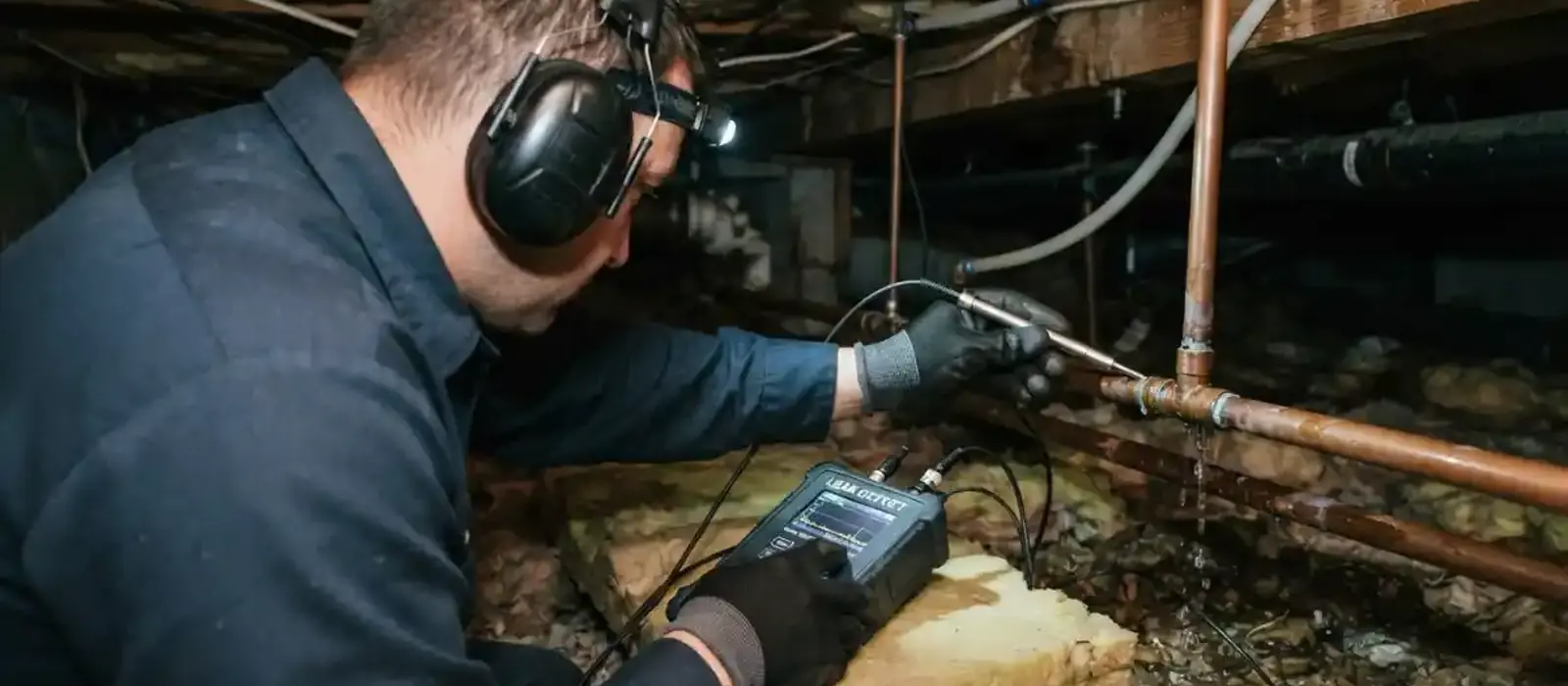
Detection uses several methods because no single tool finds every leak. Listening devices pick up the hiss of pressurized water in a pipe. Thermal imaging shows temperature differences from hot water lines or damp materials. Pressure testing isolates which line is losing pressure. Tracer gas is used in some cases where the leak is hard to hear.
| Where the leak is | What you may notice | Typical method. |
|---|---|---|
| Inside a wall or ceiling | Stain, bubbling paint, musty smell | Moisture meter, thermal imaging, acoustic listening. |
| Under a slab | Warm floor spot, meter moves, sound of running water | Isolation pressure test, then acoustic locate. |
| Service line to the house | Meter moves with main closed, wet yard | Pressure test, acoustic locate on the line. |
| Irrigation lines | Soggy lawn, low sprinkler pressure | Zone isolation and pressure test. |
| Under the house or crawlspace | Damp insulation, musty odor | Visual inspection and moisture checks. |
Slab, crawlspace and yard leaks
Many Valencia County homes sit on slab foundations, so a leak in a pipe under the floor is a real possibility. Warm floor spots, the sound of running water at night and a meter that moves are the classic signs. Our slab leak repair page explains the repair options once the leak is located.
Yard leaks show up as wet ground or a sudden green patch in dry ground. Irrigation lines are a frequent culprit, and a quick isolation test tells you whether it is the sprinkler system or the main supply.
High water bill with no obvious leak
Not every high bill is a leak. A toilet flapper that seals poorly can run constantly and cost more than most people expect. Start by checking toilets, then outdoor spigots, then the irrigation controller. If those are fine, call.
The Village of Los Lunas supplies water to more than 6,000 customers, and its Water Division is the right place to ask about billing questions and meter readings. If the Village confirms your usage is genuinely high, a plumber can search for the cause on your side.
What affects leak detection pricing
The plumber quotes before the search starts and again before any repair.
Number of suspected zones
A single wet ceiling is simpler than a whole-house search.
Type of method needed
Listening, thermal and pressure tests take different amounts of time.
Access to pipes
Finished walls and slabs are harder to inspect than open crawlspaces.
Time of call
After-hours dispatch is an emergency visit.
Repair afterward
Detection and repair are separate quotes.
Many homeowner policies cover sudden pipe leaks but not the cost of finding a slow leak. Some pay for access damage when tearing into a wall to reach a covered leak. Ask your insurer before the work. Want your real number? Describe the symptom on the phone.
Think you have a hidden leak?
Call the 24/7 line and describe what you see. A plumber can often be scheduled the same day when available.
Before we arrive: active leak or water coming through a ceiling
Do these things first to limit damage.
Close the main valve
Turn the shutoff at the house or at the meter box clockwise until it stops.
Kill power near water
Switch off breakers for any room with wet ceilings, outlets or fixtures.
Move belongings
Pull valuables, rugs and electronics out of the wet area.
Take photos
Photograph the damage and the meter reading. These help with an insurance claim.
Leaks, repairs and the Uniform Plumbing Code
Finding a leak is diagnostic work. Fixing it falls under the Uniform Plumbing Code (UPC) that New Mexico adopts, including pipe materials, joints and pressure testing. If the repair opens a wall or slab, ask whether a permit applies and who handles it.
Leak detection questions
Yes. The 24/7 line takes active leak calls any hour. Mention if water is entering a ceiling or running through a wall.
Close everything that uses water and watch the meter. If it moves, water is going somewhere. Warm floor spots, a musty smell and swollen baseboards are also signs.
Not to find it. Listening and thermal tools narrow the search first so any opening is small and targeted.
The utility is responsible for its own side of the meter. A plumber can help confirm which side the leak is on.
Yes. Irrigation leaks are a common source of wasted water and are found by isolating zones.
Yes. See Peralta, where homes often rely on private wells and septic systems.